As I look forward to being in Jesus’ garden forever, I am also trying to prepare my sisters for when I am not here. I am their big brother after all. And I long for them to experience the freedom to follow Jesus who wept at the grave and who has conquered death.
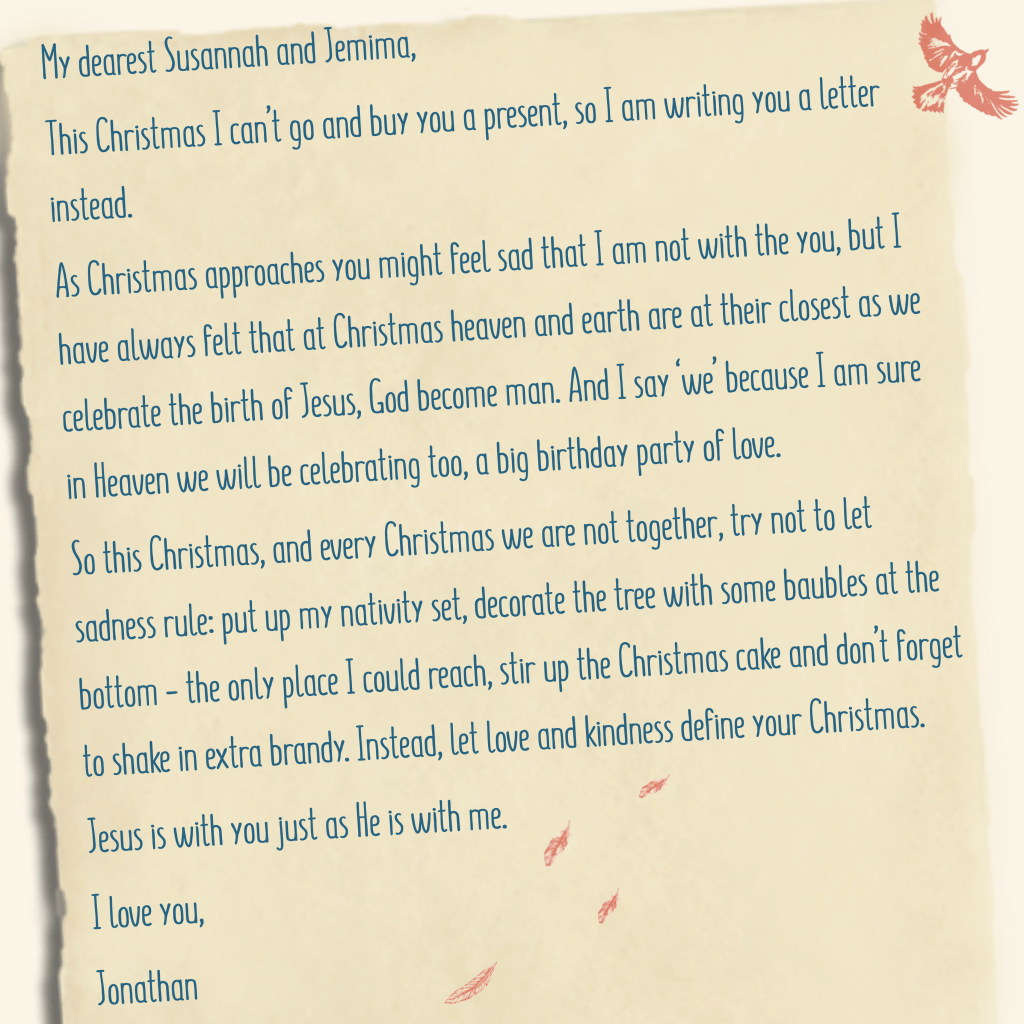
As part of that preparation he wrote a Christmas letter to his sisters, dated December 2019, with instructions for me to give it to them in preparation for their first Christmas after he died.
With their permission I share now what he wrote, in the hope it will be of some help to other people who are grieving at this time.
[Note from Chantal: I can’t remember why this essay, which Jonathan wrote for a competition at school, was not shared on his blog. We found it recently and have shared it on Teach Us Too, I thought it would be fitting to share it here also.]
Can you imagine not being able to speak? For you that would probably be a major inconvenience. But you would also find ways around it, using your hands to gesticulate and writing things down. Now imagine you can’t accurately use your hands and you’ve never been taught to read or write.
Until the age of nine this was the story of my life. I still can’t speak, but when I became literate I could spell out everything I wanted to communicate.
On entering the education system, I was assigned the label Profound and Multiple Learning Disabilities, or PMLD for short. Unlike other educational labels such as dyslexia, PMLD does not have a diagnostic test and is defined in the PMLD Standards as a ‘description rather than a clinical diagnosis’[1].
Instead this label defines the education, or rather lack of it, that you are going to receive. Many children who have very limited control of their bodies and are non-verbal are assigned this pernicious label at the start of their education. I was one of them. Without a reliable method of communication, this label is given based on outward appearances. Being very physically disabled and usually non-verbal, the untested assumption follows hat we are profoundly learning disabled, and that there is little or no point in teaching us. I’ve even read a special school head teacher describe trying to teach a class of PMLD students to read and write as abusive.
Once you are yoked with it, the assumptions made about you are seen as certainties. So, the vast majority of PMLD classes in special schools follow a sensory curriculum, with not even a glimmer of expectation that you could learn to read or write. For instance, when we had a book read to us, we never got shown the words because there was no possibility we could ever read for ourselves. It was a self-fulfilling prophecy.
So, given this was my experience at special school, how have I written this essay? When I was seven I was visited by an education expert who suggested to my mother that I could be taught basic literacy using my eyes like a cursor. Through holding up a series of letters of the alphabet in front of me, she realised I could correctly look and select the initial letter of my name and I had the potential to learn more.
The PMLD standards conclude their definition by stating ‘children and adults with PMLD have more than one disability, the most significant of which is a profound intellectual disability.’[2] Yet when I entered education, I was given the label PMLD with no assessment of my learning capabilities. And there is a reason for this: children with severe physical disabilities usually haven’t settled on an access method. In other words, how we are going to demonstrate even something as simple as yes and no is yet to be firmly established.
We can’t be assessed because we can’t demonstrate our understanding. We don’t all have Profound and Multiple Learning Disabilities; we have Profound and Multiple Access to Learning Disabilities. We can’t use the label until we have established the level, or not, of learning disability and this can’t be done until we have established access to demonstrating that.
My own journey to discovering a reliable access was not straightforward. Prior to using my eyes, I tried a variety of methods including a switch, which I struggled to press at a particular point of time; and an auditory scanning book, which required me to listen to options and smile for the one I wanted. Smiling in a set time was also difficult and who wants to smile to say they have tummy ache? Another big drawback with any communication system is that predetermined word choices will always be restrictive. For example, using my auditory scanning book I could not say I was frustrated, because the negative feelings words I was offered were limited to: sad, angry, tired, bored, scared and ill.
Once my access to learning was found I was ready to be taught. But at my special school, like many around the country, PMLD pupils are only offered a sensory curriculum. So, my mother took me out to teach me to read and write at home.
On hearing this part of my story many people remark on how wonderful my mother was to do this. But, they are missing the point: this is not wonderful, it’s outrageous. Imagine the headlines if able bodied children were looked after at school and had to be removed from school in order to be taught!
After a year and a half of a couple of hours of literacy a day, I started to spell out everything I wanted to write and say. Thus aged 9 I had my first free conversation with my family in which I could say everything in my own words. It unlocked my voice and enabled me to demonstrate clearly what I had learnt and understood. The PMLD label no longer fitted, and I joined my local mainstream school.
In the summer of Year 5, whilst recovering from being seriously ill I knew God had given me extra time to make a difference for children like me in education. All my life I’ve known the presence of Jesus with me, comforting, sustaining and now challenging me to use my newfound voice to make a difference. So, I started a campaign for all children to be taught to read and write regardless of their educational label, and my message gained traction in the press. This led to me writing my story in my book ‘Eye Can Write’.
By the time my book was published in 2018 I realised that in order to thrive my campaign needed to be seen as bigger than me, and I founded my charity Teach Us Too. Whilst using my story as a catalyst for the campaign has been useful for making professionals think about what is possible, there has also been the reaction that I am an exception, and therefore my story alone can’t be used to argue that all PMLD students should be taught to read and write.
My argument has never been that everyone labelled PMLD is capable of writing a book and studying GCSE English. But by denying literacy teaching to a whole cohort, you never find out what they may be capable of. For some it may be very simple three letter words, and for others it may just be exciting to be taught.
Recently I heard about James who went through the whole education system not being taught to read and write, only being taught literacy in his early 20s. He’s motivated and really enjoying learning for the first time. For my campaign to be successful I needed people to look beyond my story and realise the relevance of literacy for others like James.
As I’ve got older, I have also appreciated how much being literate makes me and my disabled friends independent. The education system puts much emphasis on independence, but for severely disabled people like me it is being literate, expressing ourselves and spelling out our preferences, which gives us the greatest autonomy. For example, my friend Will was pushed to Morrisons with school in order for the TA to pick items from the shelf, put them on the conveyer belt, pack them and pay for them, because Will can’t physically do that for himself. True independence would have seen Will using his eyegaze computer to do online shopping.
Using the principle of the least dangerous assumption[3], it is far more damaging for pupils not to teach them to read or write, than it is to teach them literacy. As one teacher of a PMLD class found, when she started out with the assumption ‘that children with PMLD understand everything but cannot yet tell us’, after a year of teaching not one of them fitted the label PMLD[4].
To conclude I leave you with my poem PMLD which both describes the experience of nearly all pupils labelled with PMLD, and my vision for what is possible when we start from a place of high expectations.
Footnotes:
1] Supporting people with profound and multiple learning disabilities CORE & ESSENTIAL SERVICE STANDARDS 1st EDITION, NOVEMBER 2017 Standards-PMLD-h-web.pdf (pmldlink.org.uk)
[2] Supporting people with profound and multiple learning disabilities CORE & ESSENTIAL SERVICE STANDARDS 1st EDITION, NOVEMBER 2017 Standards-PMLD-h-web.pdf(pmldlink.org.uk)
[3] A good summary is here: Least dangerous assumption – Wikipedia
Over the summer there have been some wonderful tributes to Jonathan – both privately in the hundreds of letters and cards we have received as a family, and also publicly. We are so grateful as a family for all the wonderful things that have been shared about Jonathan and the impact he has had on many lives.
Below we want to share two public tributes that have been made for Jonathan since his funeral. The first is from Sir Michael Morpurgo, a dear friend of Jonathan’s, who spoke movingly about him at the Westonbirt School speech day in July, the day after his funeral. You can read an extract of Michael’s speech below. The second is from Martin Saunders, who shared a tribute to Jonathan at the Satellites Christian Youth Festival, on the main stage one evening in front of thousands of young people. The video of Martin’s tribute is at the end of this post.
Sir Michael Morpurgo:
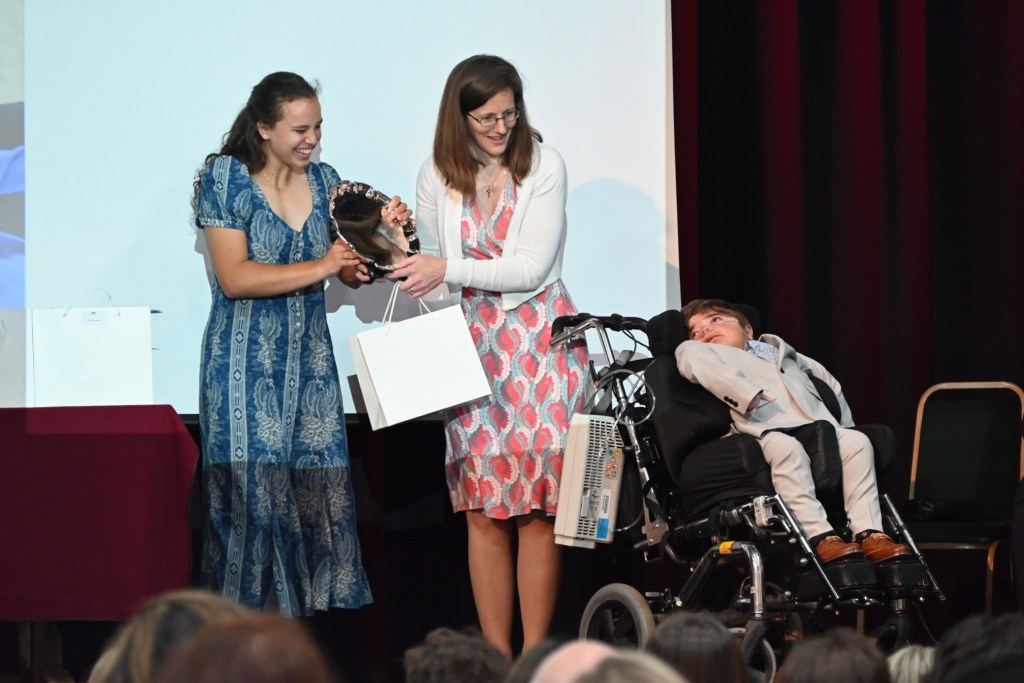
I’m a year late. I should have been here at Westonbirt a year ago to give away the prizes. I believe it was my friend, Jonathan Bryan, who had proposed that I should come. Until recently, as many of you will remember well, he was a student here. I knew him as a fellow writer who had become, over the years, a dear and good friend.
Let’s just say that circumstances prevented me from coming last year. So I’m a year late, and as it turned out a year too late. But I’m here now, so not too late.
And I’m here now because Jonathan wanted me to be. He invited me again. He was to come back a year after leaving Westonbirt and be here with you and with me today. But now, of course, it is Jonathan who cannot be here. Yet he is very much here in our hearts and minds. So I wanted to begin by speaking of him. But not in sadness. This is not a time nor a day for sadness. But rather it is a time, as prize-givings should be, for celebration and reflection and gratitude.
I was at Jonathan’s funeral yesterday along with hundreds of others, all of us there because we had been privileged and grateful to have known him, and been known by him, because he has so immeasurably enriched our lives, restored our faith in faith, our hope in hope, and in the best of humanity. And I’m far from the only one who feels like this. At the end of the funeral service yesterday, the whole packed church broke out of their sadness into loud and prolonged applause, in appreciation for his life, for his extraordinary achievements and for those close to him who had helped to make it possible.
From the first moment I met his beaming smile ten years ago, I felt at once there was a warmth and open-heartedness about him I had not known anywhere before. That smile stays with me, with us all, lives on as he does. He is where he longed to be, in his garden. But I feel he is here too, with us today, looking down on us, and smiling.
Let me tell you about our first meeting. It was in Exeter Cathedral before a concert. We had arranged to meet there through our mutual interest in poetry. I had read his work, knew already about his remarkable ability to write.
His ever-devoted family was there with him, and I knew already something of the miraculous way he had learned to communicate with those about him, that by the blink of an eye he could spell out what he wanted and needed to say or write.
But as it turned out, I was the one who didn’t know how to begin the conversation. I fumbled around, as we often do when we first meet someone, searching for the right cheery words to get things going.
So I said, “Hello, Jonathan, it’s good to meet you. Good to meet a younger writer.” His face wreathed in smiles – no one smiled like Jonathan – as he began to spell out his slow and blinking reply, letter by letter, word by word, his mother then reading out his words to me.
“And ……I think…. It’s ….good ……to meet….. an …older writer.” So that was me put firmly but kindly in my place.
We met up here and there after that first encounter, two writers out there, at this or that launch or a reading or a play. He came to visit us most years in Devon with his family. I wrote, he wrote. We became friends, fellow scribblers, exchanging poems, stories, notions, ideas, hopes.
Jonathan was on a mission to raise awareness for others, many thousands of them, in his position, awareness that they all need and deserve the same intellectual and emotional stimulation we all need from our upbringing and our education, that they mustn’t ever be stigmatised, undervalued, disregarded, or patronised, never set on one side and ignored, that everyone has potential, no matter what. And he was living proof of that.
Then I heard the glad news from his parents, who are here today, that he was going to attend a wonderful school, Westonbirt – a school, clearly with a good caring heart – which would help provide him with the support and stimulation he needed, and that then he was planning to go on to study Creative Writing at university, which is exactly what he did, in Bath – for a while, until he became ill and sadly passed away.
So Jonathan lived a fulfilled life, a life of achievement, with love and support all around him, which he gave back to us and to the world about him in spades.
Tribute to Jonathan from Martin Saunders at Satellites
As a family we have been overwhelmed by people’s kindness to us since Jonathan died a month ago – so many people have written in the various ways that people can be in contact, to offer condolences, but also to tell us of the impact Jonathan had on them. It has been overwhelming and humbling in equal measure, and we are so very proud of Jonathan and all that he was.
Wonderfully we have about 400 people coming to Jonathan’s funeral in person and a further 200 who have signed up to watch it online, which is an amazing testament to him.
Jonathan wrote his funeral a few years ago. Unusually he not only chose the music, hymns and readings, but also wrote introductions to them to explain why he had chosen them. He also went through the service book and chose every piece of liturgy, and at one point created a prayer taking bits of prayers on offer.
Below is a copy of the service sheet for anyone following along at home, and under that is the link page for the St Paul’s Church Chippenham YouTube, where the service will be livestreamed. The livestream recording will be available for a few days after the funeral.
[Jonathan wrote this in 2020 in preparation for this time]
Creating and writing this blog has been really fun, but today I am writing my last blog post, hopefully some time before it is needed, though I am ready any time.
Shortly after I started writing poetry I wrote my poem, ‘Song of Voice’, which has always been the poem which best describes me and my journey of communication. After this I wrote ‘Song of Silence’ to describe my passionate belief that all children deserve a voice of their own (though I think subsequently my reverse poem, PMLD, does this better).
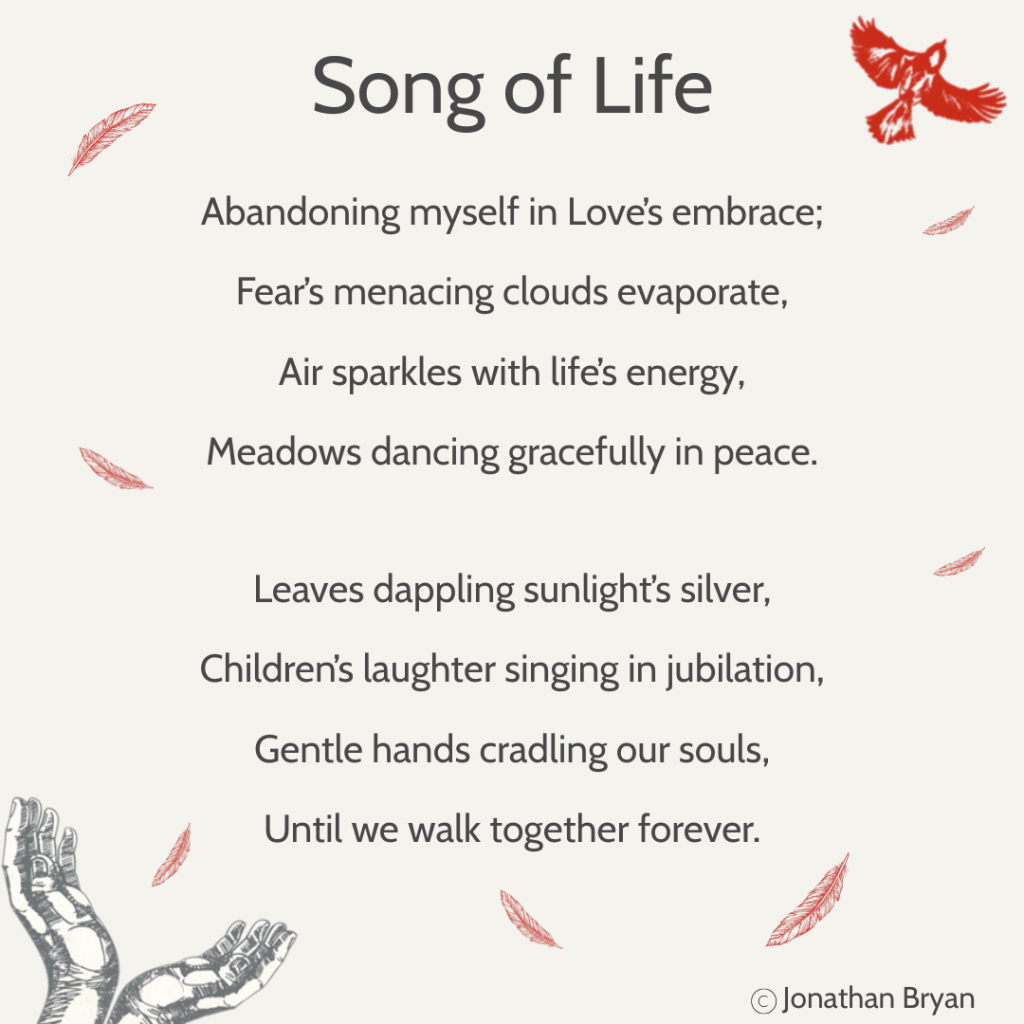
Today I present you with the last of my three songs: Song of Life. Never being sure how long I’ve had left, I originally wrote this in 2016, shortly after my other song poems, and I have now updated it during lockdown 2020.
When you read this I will be in heaven enjoying my new body and all the freedom that comes with it, but most of all I can’t wait to be with Jesus, the author and perfecter of my faith.
This year has been a year of two halves. It was the worst of times; it was the best of times.
Elements of my life completely changed, from the loss of my much loved Grannie, to saying goodbye to my paediatric team, to an illness that seemed to take hold of me, so much so, that I thought it would take me on my final journey back to Jesus’ garden. But just as the darkness seemed to become all consuming, there was light permeating through the obscurity, and a voice telling me to have faith.
As with all weathered storms, we must look for the rainbows, finding joy even in the hardest of times. On reflection, I have had much to celebrate.
During the summer, I attended the Christian festival, Satellites, where my best friend Alaric and I performed a spoken word poem in front of 5000 people. I also had the opportunity to travel to the Isle of Wight for a family holiday. During reading week I utilised the opportunity to visit Alaric in Scotland.
A pivotal moment for me was finally being accepted into Bath Spa University to study Creative Writing. As journeys go, this was not a completely straight forward one; countless emails, patiently awaiting replies and filling in forms. But the arduous nature of these tasks was worth it in the end. A pot of gold sat for me at the end of this particular rainbow in the form of great housemates and fellow students.
For the Bath Spa University carol service I was asked to write a poem on journeys with the text about the call for Mary and Joseph to register for the census as the reading. What surprised me when I researched it was the arduous nature of the journey not just in length but also in terrain, and it occurred to me that the trek they took could be a metaphor for our life as a Christian.
Whatever journeys you have been on this year I pray you have a blessed Christmas, and whatever lies ahead I pray you have a hope-filled new year.
The Journey
The first clear call was Immanuel, God with us, God for us, God alongside us, Joy rising, dampened by rumours bubbling; And peace. Amen. So be it. Then Caesar’s command to census Offered a fresh beginning, Eighty-five miles of travel, Mirrored in a lifetime of journey.
Descending the Nazareth range, We leave behind the familiar, Embrace the uncomfortable, Trusting the narrow path to be straight, When understanding is not ours to grasp.
Into the Jordan valley, Where shadows invite anxiety, Embankments funnel fear, And thickets harbour danger, We are shepherded Beside the water of life, And drink deeply.
Refreshed we press on Through Judean desert, Brutal wastelands of rock and grit, With searing daytime heat And bitter nights, We sustain each other, Not abandoned. Not deserted.
We lift our eyes up To the Judean mountains, Our feet will not slip in our ascent, Our sights fixed ahead to completion, Persevering until the fog is lifted, And we meet the face of God.
I have a dream that those of us yoked with the PMLD label rise up and shatter assumptions with our voices. A single voice is small. A couple of voices make a conversation. But the clamour of a chorus is harder to ignore.
As a voice for the voiceless I am passionate about campaigning for other people labelled with PMLD to have the opportunity to speak for themselves. But so often they remain unheard. People talk about us and for us, whilst we remain silent.
When I was 12 I wrote a book about my experience of having the label PMLD and what it was like to become literate and be able to communicate using my own words. A world of opportunity was unveiled; it opened up doors for me that would have otherwise remained closed.
That is why I am so excited about the Teach Us Too Transformational Tales project. Headed by Dr Sarah Helton we are going to capture what literacy means in the words of learners with complex needs.
This trimeric poem in its repeated lines from the first stanza represents the cyclical frustrations I have encountered in amplifying the voices of others, but the last stanza is one of hope. A hope that this project can at last release the authentic lived experience of people labelled with PMLD. It’s time you heard our own song.
The highlight of my summer was attending the Satellites youth festival at the Bath and West showground. This is an event where young people can explore their faith through a variety of worship, workshops, games and seminars, all whilst having a great time together. I even had the opportunity to showcase some of my skateboarding skills, with some assistance of course! On the last evening there was a fancy dress party with a Disney theme, where there were some pretty amazing costumes – I dressed up in a cardboard box as Wall-E.
I was honoured to be asked, with my friend Alaric, to write a poem about disability, inclusion in church, Jesus and friendship. This was filmed and shown on screen in front of 4000 worshippers, and the response from everyone was amazing. Alaric and I spent many hours planning, writing and filming, but the results made people think about inclusion in faith and how acceptance is the key to true accessibility. Our aim was to get people to challenge their own prejudices, whether they be unconscious bias or otherwise, to look beyond disability, to see the gifts which God has bestowed on all of His children.
The hope was that we could shift perspectives on accessibility and inclusion from being merely tokenistic acts to instead recognising the value of every member of our Christian community. This is turn sets us on a path of true acceptance and a deeper understanding of what it means to have a relationship with God.
Video of the time we shared our poem at Satellites.
My journey at Westonbirt started during lockdown when I was invited to join their English Literature class via Zoom, so when it came to choosing where I wanted to study for A-levels it was my obvious choice. I studied English Language which was fun and also a bonus as my class consisted of myself and three girls, and I went on to study more English Literature and Psychology.
During my two years there I have enjoyed social trips and events and spending time in the Sixth form block having a blast and showing off my pool skills. I was honoured to be accepted to represent students in my role as inclusion officer in Diversity, Equity and Inclusion and found new interests in clubs such as History of Art, Tea and Politics and War Games, and was also included in playing rounders, in which, I can assure you, I never cheated…
On Saturday 6th July I attended speech day at Westonbirt School; sadly this meant the end of my amazing time studying there. I will miss my great friends and teachers who made me feel very included, but am extremely excited to be starting my next journey at Bath Spa university studying creative writing.
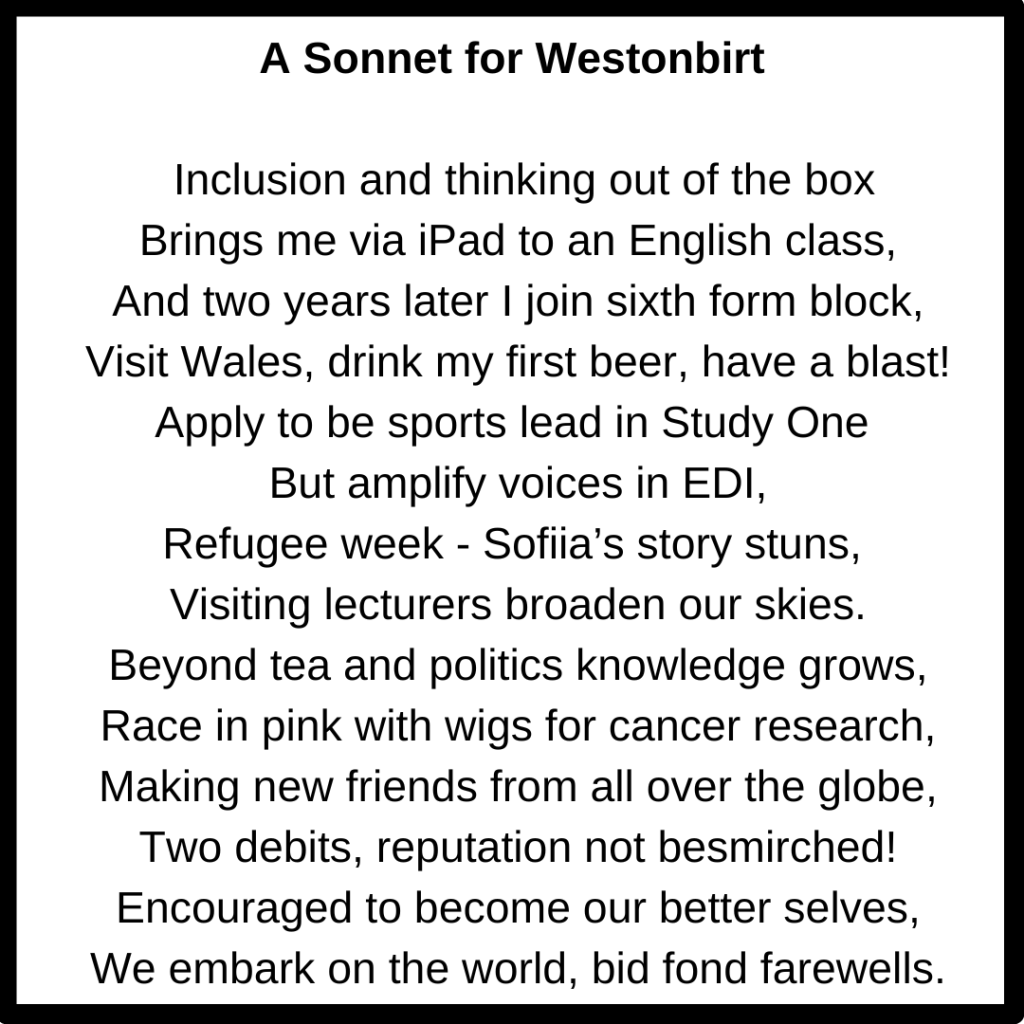
On speech day I shared a sonnet about my time at the school:
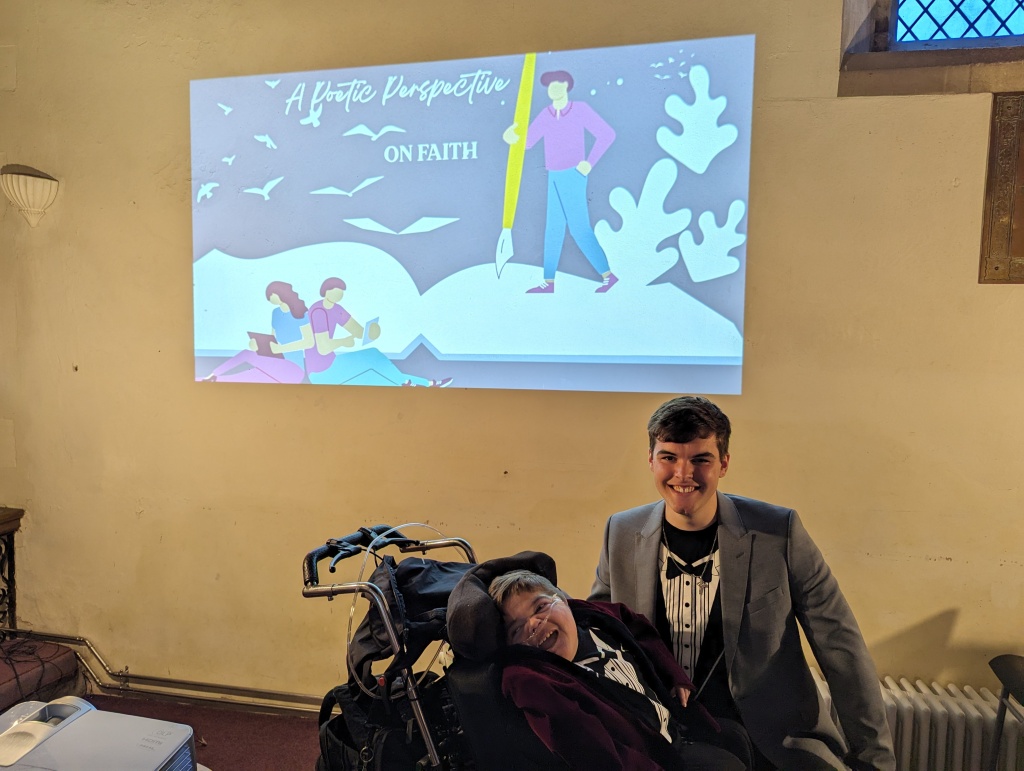
On Saturday my friend Alaric and I ran a poetry evening in church, which we called a Poetic Perspective on Faith. I shared a short presentation about biblical poetry (based on a talk by The Bible Project); we shared poems we had either written or enjoyed, and wrote a group poem about summer with each table writing a couplet. It was a wonderful evening.
Here is the piece I shared:
What does renewal mean when you are seriously ill? This is a question I attempted to answer based on my experience of being very ill in March, and to enter the Association of Christian Writer’s spring competition.
Isaiah 40 verses 29 to 31 says:
He gives strength to the weary and increases the power of the weak. Even youths grow tired and weary, and young men stumble and fall; but those who hope in the Lord will renew their strength. They will soar on wings like eagles; they will run and not grow weary, they will walk and not be faint.
This talks of the difference that hope in God makes; and I wanted to explore this in poetic form from my experience of getting close to my end, but it not being quite my time yet. Getting better took me 6 weeks, but it felt longer.


 Eye Can Talk